


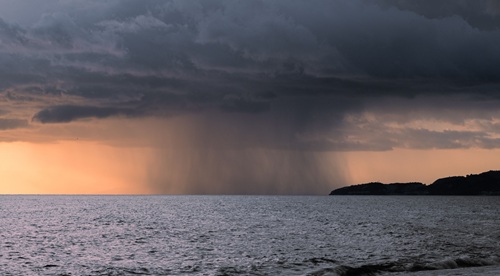
On the open sea, weather is a critical safety factor. Unlike on land, large-scale and local atmospheric processes have a particularly direct impact here—without the protective landscape features that could mitigate wind or pressure differences. Understanding the relationship between air pressure and wind allows you to recognize weather changes early on and avoid risks. Below, we provide valuable insights into these mechanisms.
Air Pressure as a Key Weather Indicator
The global distribution of air pressure is uneven due to differences in how various latitudes warm up, the arrangement of continents and oceans, and atmospheric circulation patterns.
Air pressure is one of the most important parameters for weather forecasting, especially at sea. Barometers are therefore standard equipment on every ship and yacht. They measure pressure in hectopascals (hPa) and thus indicate whether a high- or low-pressure system is approaching.
• Rising air pressure indicates stable, calm weather.
• Falling air pressure signals a deterioration in weather conditions, often accompanied by
increasing wind, rain, or storms.
• Rapid changes in pressure are warning signs of strong winds or severe weather.
At sea level, the global average air pressure is 1013.25 hPa. Readings of 990 hPa or lower indicate a pronounced low-pressure system, while readings above 1025 hPa signal a strong high-pressure system. Especially at sea, where weather services are not always available, a barometer allows for a reliable assessment of the coming hours.
How wind forms—and why it blows stronger at sea
 Wind is caused by differences in atmospheric pressure. Air generally flows from areas of high pressure to areas of low pressure, and the strength of the wind depends on the magnitude of this pressure difference—the greater the difference, the stronger the wind blows.
Over the ocean, these differences are often more pronounced than on land. This is primarily because friction over water is significantly lower, so the wind is slowed down less. In addition, the more even temperature distribution over the ocean ensures that fewer extreme local pressure differences form, as they do on land due to surfaces heating up at different rates. Furthermore, there are hardly any obstacles such as mountains, forests, or buildings on the open water that could weaken the wind.
For these reasons, the wind over the sea is usually stronger and more consistent. Even small changes in air pressure can lead to noticeable increases in wind speed there.
Land and Sea Breezes: Thermal Wind Systems
A particularly clear example of the interaction between temperature, air pressure, and wind is the land-sea wind circulation.
During the day:
• Land warms up faster than water.
• The warm air over land rises → a low-pressure system forms at the surface.
• Over the cooler water, the air remains denser → a high-pressure system forms at the surface.
• A sea breeze blows from the water toward the land.
At night:
• Land cools down faster than water.
• A high-pressure system forms over land, and a low-pressure system over water.
• A land breeze blows from the land toward the sea.
This pattern is particularly pronounced along coasts and large lakes and can be intensified or weakened by large-scale winds, depending on weather conditions.
Why accurate measuring instruments are essential on board
 In addition to barometers, hygrometers, climate meters, and clocks also play an important role:
• Hygrometers measure relative humidity and provide indications of fog formation or impending rain.
• Marine clocks aid in navigation, logbook keeping, and time management—essential for safe navigation.
There are also combination instruments that combine barometers, thermometers, and hygrometers, providing a compact overview of the most important weather parameters.
Monitoring Weather Conditions at Sea with Our Measuring Instruments
Air pressure and wind are the two key factors that determine the weather on the open sea. Falling air pressure often signals stronger winds and rough weather, while rising pressure promises calm and stability. Wind, in turn, is caused by differences in pressure and has a particularly strong effect at sea, as there is little friction or obstacles.
Those who understand the relationships between air pressure, wind, and temperature—and have the right measuring instruments on board—can identify weather developments early and navigate safely.
Do you have questions about monitoring weather at sea? Contact us. We’d be happy to advise you!