


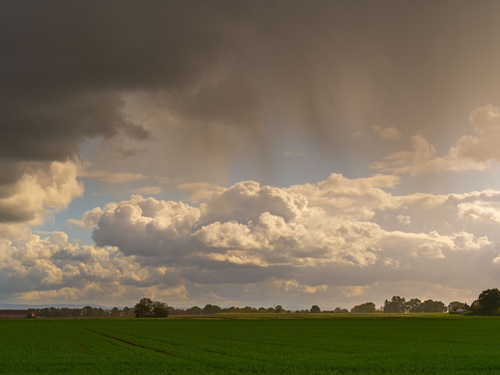
Air pressure is one of the most reliable indicators for predicting upcoming weather conditions. For farmers, those working outdoors and anyone who wants to understand how the weather develops, keeping an eye on air pressure is often more valuable than any app. When the pressure rises or falls, the weather changes – usually following clear patterns that can be easily interpreted with a little experience.
Atmospheric pressure: The physical principles
Air pressure describes the weight of the column of air above a specific point. High pressure means that the air is heavier, denser and sinks. Low pressure means that the air rises, becomes lighter and promotes cloud formation.
These physical processes form the basis for typical weather phenomena:
- High-pressure systems — stable, mostly dry weather
- Low-pressure systems — changeable, often wet weather
- Fronts — transition zones between air masses, frequently accompanied by precipitation
Falling air pressure: a sign of changeable or bad weather
A drop in air pressure is a classic sign that the weather is about to take a turn for the worse. It usually indicates the approach of a low-pressure system, which is accompanied by increasing cloud cover, rain and freshening winds. At the same time, humidity often rises, significantly increasing the likelihood of thunderstorms. The atmosphere becomes more unstable overall, meaning that the weather can change rapidly within a short space of time.
A rapid drop in pressure is particularly telling: it often indicates heavy rainfall or even a storm. Farmers make targeted use of this information to bring forward harvest work or to protect sensitive crops in good time before the weather changes.
Rising air pressure: stability and calmer weather
 When air pressure rises slowly and steadily, the atmosphere becomes increasingly stable. This usually leads to less cloud formation, a lower probability of precipitation and, overall, calmer, often sunny spells. A rise in pressure following a low-pressure system therefore often signals a prolonged spell of fine weather. For the agricultural sector, this is ideal for harvesting, haymaking or tillage, as several consecutive dry days become much easier to plan for.
A rapid rise in air pressure during unsettled weather, on the other hand, is usually followed by an equally rapid fall and, in such cases, tends to signal a continuation of the unsettled conditions – with variable cloud cover, gusty winds and isolated showers rather than a genuine improvement in the weather.
Typical atmospheric pressure patterns and their interpretation
Air pressure rarely varies at random. It follows specific patterns that are easy to interpret:
- Slow rise in pressure — stable high-pressure system, good weather for several days
- Slow fall in pressure — approaching low-pressure system, rain within 12–36 hours
- Sharp drop in pressure — risk of storms, thunderstorms, heavy rainfall
- Sharp rise in pressure — rapid improvement in the weather, often clear skies
- Constant pressure — stable weather conditions with no major changes
These patterns are particularly valuable because they apply locally – regardless of large-scale weather forecasts, which often cover entire regions and cannot always take local characteristics into account.
Why air pressure is such a reliable indicator of the weather
Unlike temperature or wind, air pressure reacts directly to large-scale atmospheric processes long before these changes become perceptible to humans. This makes it easy to detect at an early stage, straightforward to interpret and, moreover, less susceptible to short-term, local influences. That is why meteorologists, sailors, mountaineers and farmers have been using barometers for centuries to reliably predict weather developments without having to rely on complex technical equipment.
Practical significance for everyday life and agriculture
 For the agricultural sector in Saxony – and everywhere else – air pressure is a key parameter in planning sowing and harvesting, in irrigation management, in protection against severe weather, and in the general optimisation of field operations.
Air pressure is also helpful in everyday life: for example, anyone who suffers from headaches when the pressure drops, or who is planning an outdoor activity, will benefit greatly from checking the barometer regularly so they can adapt to changes in good time.
Conclusion: Air pressure is at the heart of every weather forecast
Rising pressure usually means calm, whilst falling pressure means movement – and it is precisely this dynamic that makes air pressure so valuable. Anyone familiar with the typical patterns can often predict changes in the weather hours or even days in advance and plan ahead accordingly.
In the BARIGO online shop, we offer a wide range of precision analogue barometers, weather stations and clocks. This enables you to make reliable weather forecasts and plan your outdoor activities accordingly. If you have any questions about our measuring instruments, we’re happy to help – please get in touch!